Purim is coming! Join us for our Purim Celebration outside behind the Bothwell Arts Center. We’ll have a Purimspiel, costume parade, crafts and hamantaschen to take home. Kids not required–fun for all. Masks are required for all attendees.
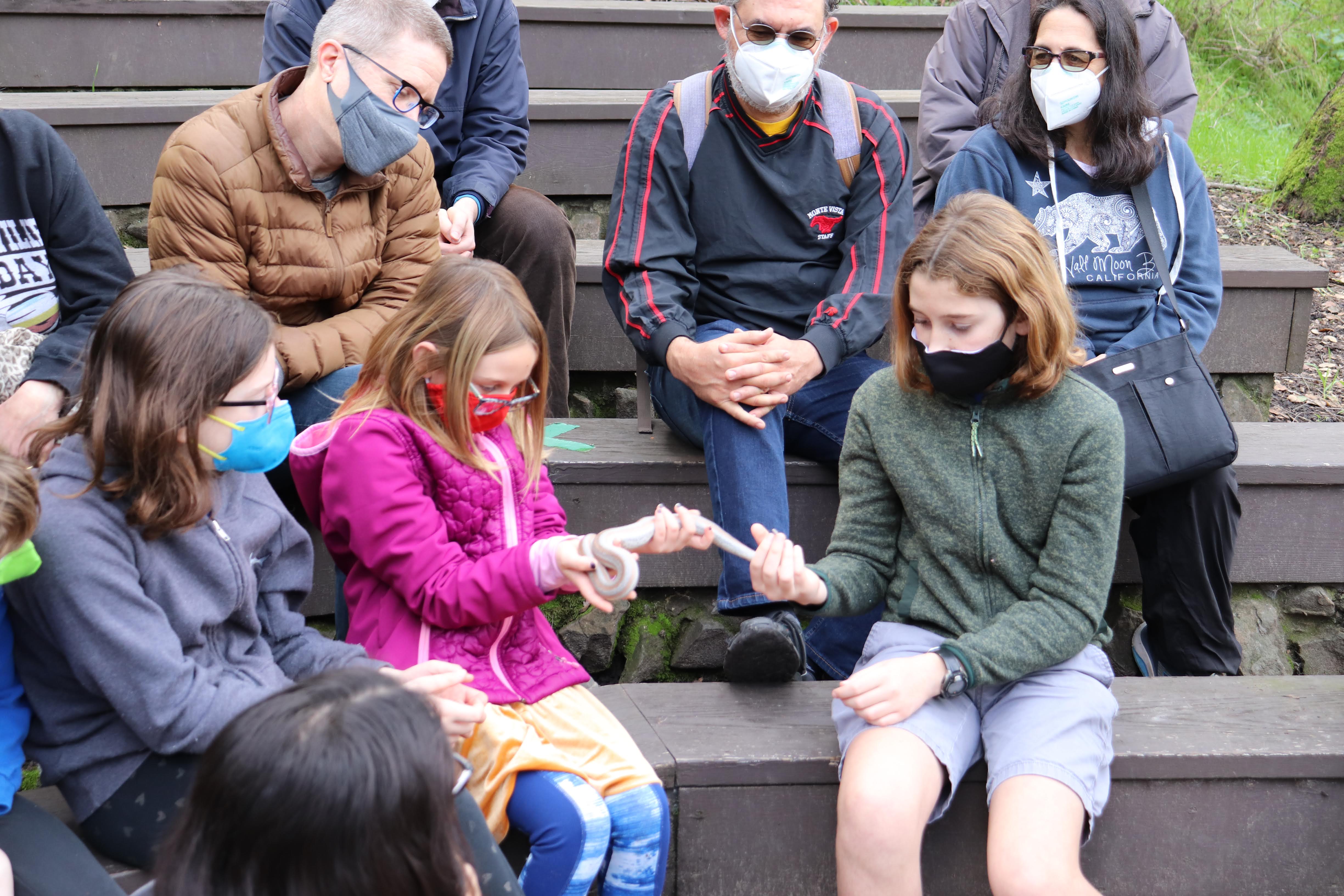
Our Tu B’Shvat event at the Sulphur Creek Nature Center was so much fun. The Nature Center is located in a beautiful area of Hayward, sheltered by trees. Christine was a wonderful host who introduced us to a few very special friends: a rosy boa, a banded dove, a bantam hen and a chinchilla. We were able to crack plum seeds and pot them to take home. Happy Tu B’Shvat Everyone!
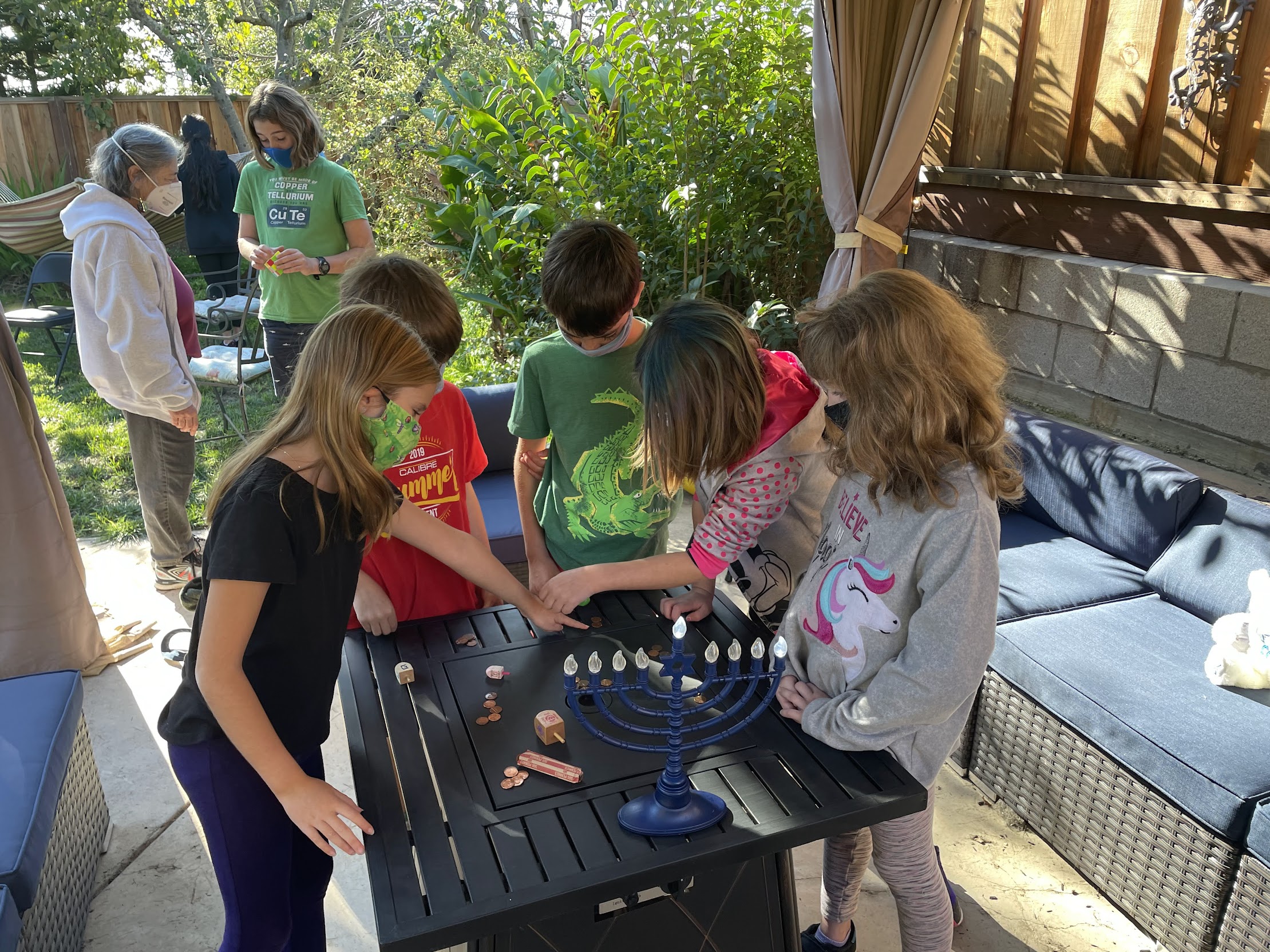
Hanukkah 2021 was another adventure! Many thanks to the Mogilefskys for hosting our outdoor gathering. Everyone enjoyed their climbing wall and hammock, as well as meeting their gorgeous pets. We lit our giant Menorah, as is our custom, played dreidel, and had a Hanukkah trivia guessing game with gelt prizes. Although no latkes were cooked communally this year, jelly donuts or sufganiyot, were available as take-home treats. As always, we found another way to welcome the light into our lives and into the world. Pictures can be found (and uploaded!) here: https://photos.app.goo.gl/RB32f6Wv9oSD9u7u7
Join us outside to celebrate the Festival of Lights on November 28 at 10:30am (address to follow in evite). Come for games, music, and a short secular, humanistic ceremony. Jelly donuts and gelt will be available to take home. Masks are required for all in person attendants. Zoom details to follow in evite for remote attendance.
Date: Sunday, November 28 Time: 10:30am Cost: Free to members; suggested donation $10/non-member
Every year, as part of our Shavous celebration, we all recommend our favorite books from the past year. Here are this year’s recommendations from some of our members.
You can click on any title to be taken to an Amazon page to order that book.
As this is the holiday in which we traditionally celebrate the torah- we celebrate other books that have meaning for us. So we get together to share the best books we’ve read the past year….and with Covid- I am sure those lists are pretty long.
We will gather on Zoom at 10:30 on May 16. Zoom Meeting ID is 568 599 7884
If you don’t do what I say, then I’m going to hurt someone you don’t care about! Does that sound like a good way to force someone to do what you want? No? But that’s what happens in the story of Pesakh (Passover).
Ancient Egypt was ruled by an absolute monarch who owned all land and whatever it produced. The entire populace worked for him. We read in Genesis that all the grain in the country belonged to the Pharaoh and that the people who grew the grain then had to pay the Pharaoh if they wanted some to eat. Clearly, the Pharaoh did not care about the residents of Egypt.
The story tells us that after Moses asked the Pharaoh to let the Israelites leave and the Pharaoh’s refusal, 10 plagues befell Egypt to force the Pharaoh to accede to Moses’ request.
Why didn’t the first 9 plagues work? Water pollution, frogs, lice, wild animals, livestock disease, boils, hail and locusts devastated ordinary Egyptians. Even if the locusts ate the crops, whatever was left went to the Pharaoh. Giant hail didn’t hurt the Pharaoh’s palace as it might the homes of poorer people. Livestock disease meant that the ordinary farmers had nothing to eat and didn’t have livestock to sell to buy food from the Pharaoh. All these terrible plagues did nothing to change the Pharaoh’s mind because they happened to people he did not care about. Not until the 10th plague that killed his heir did he relent.
So, why did the authors of the story have the god send the first nine plagues, these destructive natural disasters? It was pretty obvious that they wouldn’t work to affect the ruler. They only hurt ordinary people who weren’t responsible for the economic system of the country.
Well, I don’t really know why the authors included this story – although one can assume it was to show the power of their god – but I do know what we can learn from it because we see the lessons playing out in our time. We see that natural disasters devastate ordinary people but that big shots like, say, US Senators, can always escape them. If we’d paid attention to the plague story, we’d have been less shocked. We see that economic sanctions that countries put on other countries really hurt only the ordinary people – not the Ayatollahs or the Putins. If we’d paid attention to the plague story, we’d have known this.
So let’s remember when we try to influence other countries that hurting ordinary people is not the best way to achieve our goals. And let’s remember that we should elect officials who actually care about ordinary people.
For Tu B’Shvat, all TVCJ members received a package of parsley seeds, along with instructions on how to plant and care for them. The seeds we planted then are growing nicely, and will be a wonderful addition to our upcoming Passover Seder.
The TVCJ annual community Seder will be held virtually on Sunday, March 28, 2021 at 5 p.m via Zoom. Everyone will participate in the comfort of their own home. Our progressive, secular humanistic Seder includes English-language readings highlighting the power of community and the value of freedom, along with songs in English, Yiddish and Hebrew. The hour-long ceremony is followed by optional schmoozing time while your family eats the dinner that you’ve prepared in your home. The event is family-friendly. We will provide a shopping list for your seder plate, suggested recipes, and the Passover Haggadah. We ask non-member adults to give a donation of $10 if you are able to support our programming.
If you have any questions or if you would like to be put on the evite list for this event, please email culturaljews@gmail.com
February 27th at 7pm. Our Purim Havdalah will be a Zoom event. Maya will share her Brit Mitzvah project on Purim and we will discuss the significance of this unique holiday. We will have fun for everyone… a costume contest and a charade game – we will guess which character you are acting out (Purim related or not).